

The Biggest Leadership Risk Today Isn't AI. It's Leaders Who Can't Adapt.
Every week, there seems to be a new headline about artificial intelligence, economic uncertainty, workforce disruption, or changing employee expectations.
Organisations are investing heavily in technology.
They're redesigning processes.
They're accelerating digital transformation.
Yet many are overlooking a much bigger challenge.
Leadership capability.
Because no matter how advanced the technology becomes, organisations still rely on people to make decisions, solve problems, navigate uncertainty, and lead teams through change.
And that is where many leaders are struggling.
The Workplace Has Changed. Leadership Hasn't.
Too many leaders are still operating with a mindset that worked ten years ago.
Control instead of trust.
Reaction instead of reflection.
Activity instead of strategy.
The result?
Teams become dependent instead of empowered.
Problems escalate instead of being solved.
Decisions get delayed.
Opportunities are missed.
And employees become disengaged.
In a world that changes daily, reactive leadership is becoming one of the biggest barriers to organisational success.
Why Technical Expertise Is No Longer Enough
Many supervisors and managers were promoted because they were excellent at their jobs.
But leadership today requires much more than technical competence.
It requires the ability to:
-
Think critically under pressure
-
Make decisions with incomplete information
-
Adapt quickly to changing circumstances
-
Coach rather than command
-
Build trust across diverse teams
-
Lead through ambiguity
These are not technical skills.
They are thinking skills.
And they have become essential.
The Cost of Reactive Leadership
Reactive leaders spend their days putting out fires.
Every issue becomes urgent.
Every challenge becomes a crisis.
Every decision feels rushed.
Over time, this creates exhausted teams, frustrated employees, and leaders who are constantly overwhelmed.
The irony is that many workplace problems are not caused by poor execution.
They are caused by poor thinking.
The inability to step back, analyse situations objectively, and respond strategically.
The Leaders Organisations Need Now
Today's most effective leaders are not necessarily the smartest people in the room.
They are the most adaptable.
They know how to pause before reacting.
They ask better questions.
They challenge assumptions.
They remain calm when circumstances change.
And they help others navigate uncertainty with confidence.
Most importantly, they understand that leadership is not about having all the answers.
It is about creating the conditions for better decisions, stronger collaboration, and better outcomes.
From Reactive to Intentional Leadership
The organisations that thrive over the next decade will not be those with the most technology.
They will be those with leaders who can think differently.
Leaders who can combine clarity with agility.
Confidence with empathy.
Strategy with action.
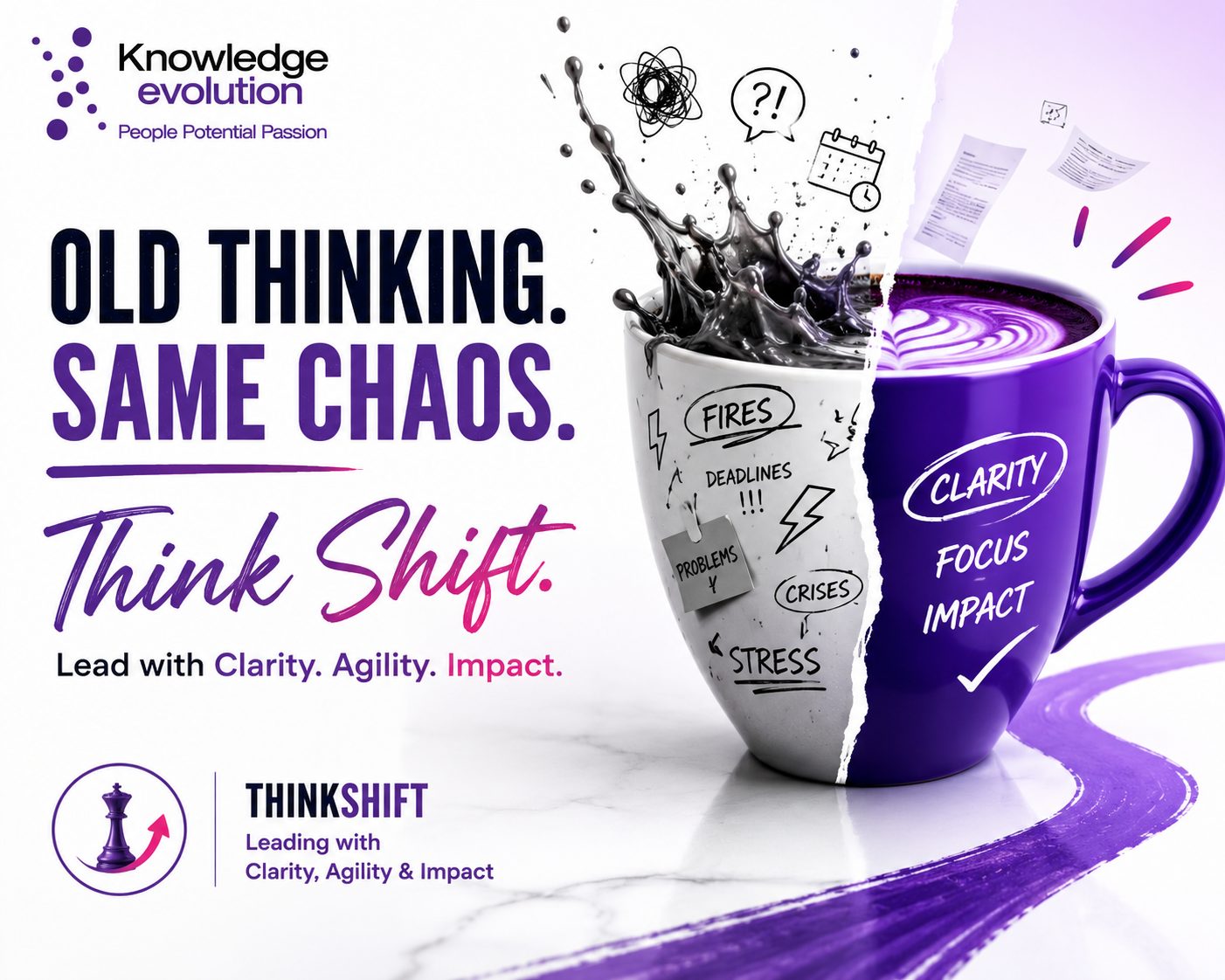
That is the focus of ThinkShift: Leading with Clarity, Agility & Impact.
Designed for Team Leaders, Supervisors, and Managers, the programme helps participants develop the mindset, decision-making skills, emotional intelligence, and leadership agility needed to navigate today's fast-changing workplace.
Through simulations, peer coaching, real-world scenarios, and practical workplace application, participants learn how to shift from reactive leadership to intentional leadership.
Because the future belongs to leaders who can adapt their thinking as quickly as the world around them changes.
And that shift starts with how they think.